
Why Brazil costs more than it seems? And how to enter without paying that price
Every foreign company that decides to enter Brazil starts with a spreadsheet. Revenue projections, estimated margins, break-even timeline. The problem is that this spreadsheet almost never accounts for what the Brazilian market actually charges in practice.
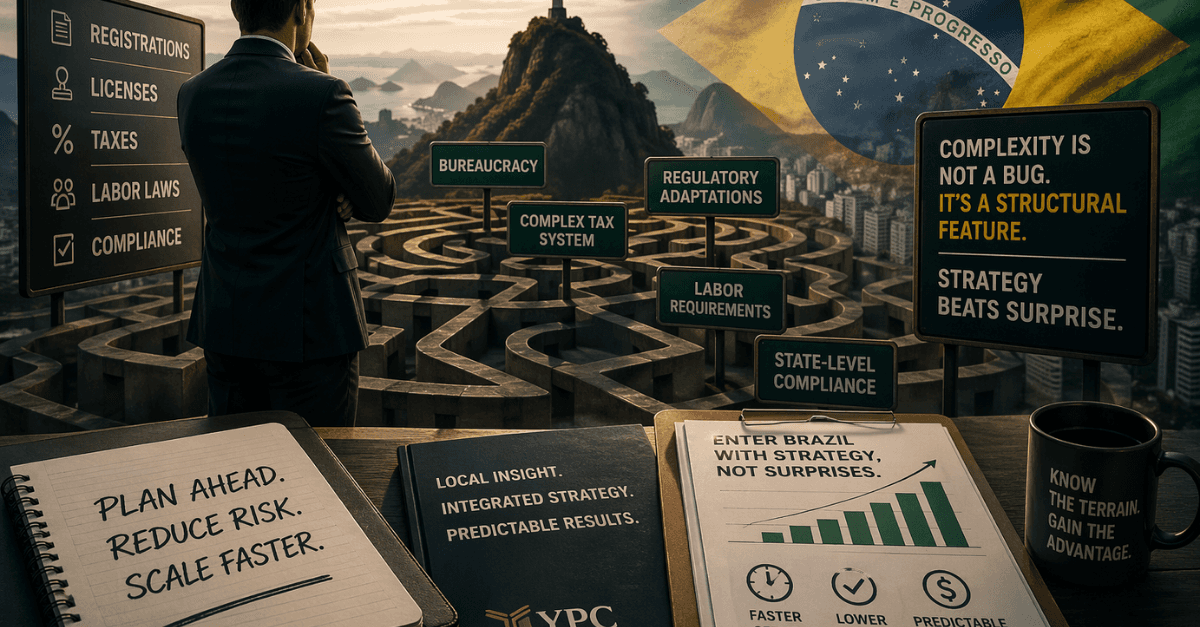
We’re not just talking about taxes, although Brazil’s tax system is a chapter of its own. We’re talking about a set of operational frictions that silently and progressively increase the cost of entry: registrations, licenses, regulatory adaptations, labor requirements, and state-level tax compliance.
What no local consultant tells you upfront
Most foreign companies underestimate three critical factors: the real time required for legal structuring, the impact of labor laws on hiring costs, and the gap between what is formally required and what is actually practiced in the market. This gap between law and practice is where the greatest risks lie — and also the greatest opportunities for those who know how to navigate it.
Brazil does not penalize those who don’t know the rules. It penalizes those who act as if the rules were simple. Complexity is not a bug in the system — it’s a structural feature that demands strategic preparation, not just legal compliance.
The decision that separates those who scale from those who stagnate
Companies that enter Brazil with partners who understand the terrain — not just lawyers and accountants, but strategic consultants with an integrated view of finance, operations, and go-to-market — are able to compress setup time, avoid regulatory rework, and reach revenue generation with expected costs, not unexpected ones.https://ypcbrasil.rds.land/know-ypc
The question is not whether it’s worth entering Brazil. A market of 215 million consumers speaks for itself. The question is how much you will pay to discover what could have been mapped in advance.
Request a free strategic assessment with YPC: